
The Sensex closed eight points lower at 5,759. The Nifty finished at 1,812 - up six points.

Market benchmarks gave up intra-day gains to close in the red for the sixth session on the trot on Friday, capping a bruising week which saw a massive dash for safety amid rate hikes by global central banks and fears of slowing growth.

Tech Mahindra was the top loser in the Sensex pack, shedding over 3 per cent, followed by NTPC, IndusInd Bank, Kotak Bank and Reliance Industries. NSE Nifty fell 185.60 points to 17,671.65.

In the absence of major domestic events, equity markets will be driven by global trends, foreign fund flows and movement in the Brent crude oil, analysts said. The major global events this week are the European Central Bank interest rate decision and China's inflation rate, they added. "Indian equity markets are outperforming most of their global peers and trying to show resilience despite weak global cues.

Benchmark stock indices Sensex and Nifty tumbled nearly 1 per cent on Wednesday due to profit booking in banking, financial and IT stocks after a recent rally. The 30-share BSE Sensex plunged 537.22 points or 0.94 per cent to end at 56,819.39 as 24 of its stocks declined. During the day, it tanked 772.57 points or 1.34 per cent to touch a low of 56,584.04. The broader NSE Nifty declined by 162.40 points or 0.94 per cent to 17,038.40 with 39 of its constituents ending in the red. Bajaj Finance was the biggest loser among Sensex stocks, dropping by 7.24 per cent.

The recovery was led by pharma majors led by Dr Reddy's Labs.
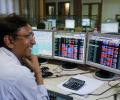
Equity indices overcame a wobbly start to clock gains for the third session on the trot on Tuesday, propped up by banking, metal and energy stocks amid a mixed trend in global markets. A recovery in the rupee also bolstered sentiment, traders said. The 30-share BSE Sensex advanced 246.47 points or 0.45 per cent to settle at 54,767.62 after starting the trade on a weak note. In a volatile session, the benchmark hit a high of 54,817.52 and a low of 54,232.82 during the day.

Trading volumes for the equities cash segment remained soft, even as the benchmark indices rallied nearly 9 per cent in July. Meanwhile, volumes in the futures and options (F&O) market dipped marginally, but continued to hover at record levels. In July, the average daily turnover (ADTV) for the cash segment was Rs 46,602 crore, up 4.5 per cent month-on-month (MoM), but 26 per cent lower than the preceding 12-month average.

The S&P BSE Sensex shed 119 points to close at 27,977 and the Nifty50 dropped 45 points to finish at 8,591.
.jpg)
Benchmark share indices ended lower on profit taking after they touched record highs in the previous session.

Analysts caution against volatility and recommend buying stocks of companies that are on strong fundamental footing that have been beaten down badly in the recent carnage.
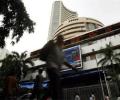
Markets recorded their biggest single-day fall since August 1 amid growth concerns in the euro zone.

The Adani story has only one angle -- how the stocks were rigged up to ridiculous heights, the Hindenburg report on gross overvaluation, followed by the vertical free fall of Adani stocks, points out Debashis Basu.

The 30-share Sensex ended down 66 points at 28,438 and the Nifty ended down 15 points at 8,633.

Infosys was the top Sensex loser along with other index heavyweights ITC and HDFC.
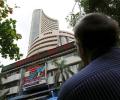
Financials were the top losers after sharp gains in the previous session along with ITC

Investor wealth slumped by a whopping Rs 5.3 lakh crore on Friday as the benchmark BSE Sensex crashed more than 1,900 points to post its biggest single-day fall in nearly ten months. At the close of trade, the total market capitalisation of BSE-listed companies eroded by Rs 5,37,375.94 crore to Rs 2,00,81,095.73 crore. The total market capitalisation of these companies stood at Rs 2,06,18,471.67 crore on February 25.

Sliding for the fourth straight day, the BSE Sensex shed 152 points in choppy trade on Wednesday amid mixed global cues ahead of the US Federal Reserve's policy decision.

The 30-share Sensex ended 79 points lower at 26,909 and the 50-share Nifty closed 25 points lower at 8,102.
At the BSE, 1,791 stocks declined, while 948 advanced, 110 stocks remained unchanged.
Markets snapped their 8-day winning streak.

'This fall is nothing. We could see worse if everybody hits the panic button.'

Ajit Mishra answers reader queries on the stock market.

The broader NSE Nifty plunged 119.15 points, or 1.01 per cent, to 11,709.10.

Equity benchmarks began the week on a downbeat note on Monday, weighed by heavy selling in market heavyweight Reliance Industries and persisting weakness in global bourses. The rupee plunged to its lifetime low against the US dollar amid unabated foreign fund outflows, underscoring the risk-off sentiment prevailing globally as central banks embark on policy tightening to tame soaring inflation. Slipping for the second straight session, the 30-share BSE Sensex shed 364.91 points or 0.67 per cent to close at 54,470.67.

Auto stocks are weighing on the indices.

Auto and index heavyweights Reliance Industries and ITC were the top losers in early trades.

'12250 should be considered a reasonable level to re-enter into the market.'

Investor wealth on Wednesday diminished by Rs 1.84 lakh crore amid massive sell-off in the equity market.
Rate-sensitive sectors like banks, realty and auto witnessed heavy selling pressure ahead of the RBI Monetary policy which is scheduled on September 29.
The Sensex ended at a fresh record closing high of 28,889 while Nifty ended at a fresh record closing high of 8,730.

Investors sought to book profits at attractive valuations after recent run up in last few trading sessions.

'Rising Covid cases and localised lockdowns are being closely monitored.'

Retail investors have gained significant heft in the past year amid a sustained uptick in Indian equities. The share of retail investors in companies listed on the NSE reached an all-time high of 7.32 per cent in the quarter ended December 31, 2021, up from 7.13 per cent in the previous quarter and 6.9 per cent a year ago, the data from PRIME Infobase shows. This was despite the Nifty's 1.5 per cent decline during the quarter.

So far in September, the S&P BSE Small-cap index has gained nearly 3 per cent as compared to a modest 0.2 per cent dip in the S&P BSE Sensex.

On the Sensex chart, Yes Bank was the worst hit with 7.81 per cent decline. It was followed by Tata Steel, Vedanta, M&M, IndusInd Bank and Tata Motors -- shedding as much as 5.07 per cent.

The mid- and small-cap indices had a dream run between January 2017 and January 2018 - zooming 48 per cent and 56 per cent, respectively.

'You can put 25 per cent right now; put another 25 per cent when Nifty corrects another 500 points.' 'At 13,500 put another 25 per cent and at 13,000 one can get fully deployed.'
Caution prevailed across the bourses ahead of the Union Budget.
The latest circular from BSE that sought to cap the price movement of select scrips, especially the mid-, small-cap segments, traded on the exchange is not without a reason. A quick calendar year-to-date price check on the stocks from the categories put under 'Add-on Price Band Framework' by the BSE reveals a total of 210 stocks have seen their market price more than double. Among individual stocks, SC Agrotech, Adinath Textiles, Waaree Renewable Technologies, Steel Strips Infrastructure, Unistar Multimedia, Texel Industries, Raja Bahadur International and Hindustan Everest Tools from the BSE's X and XT group have rallied over 500 per cent during this period. Topping the charts is Gita Renewable Energy, which has zoomed 3,964 per cent to Rs 272.35 now from Rs 6.7 as on December 31, 2020.
